Daycare Security in Florida: Licensing, Access, and the Drop-Off Moment
Florida daycare security beyond DCF licensing. Access control, drop-off protocols, background checks, and what keeps children safe in Fort Myers and Naples.
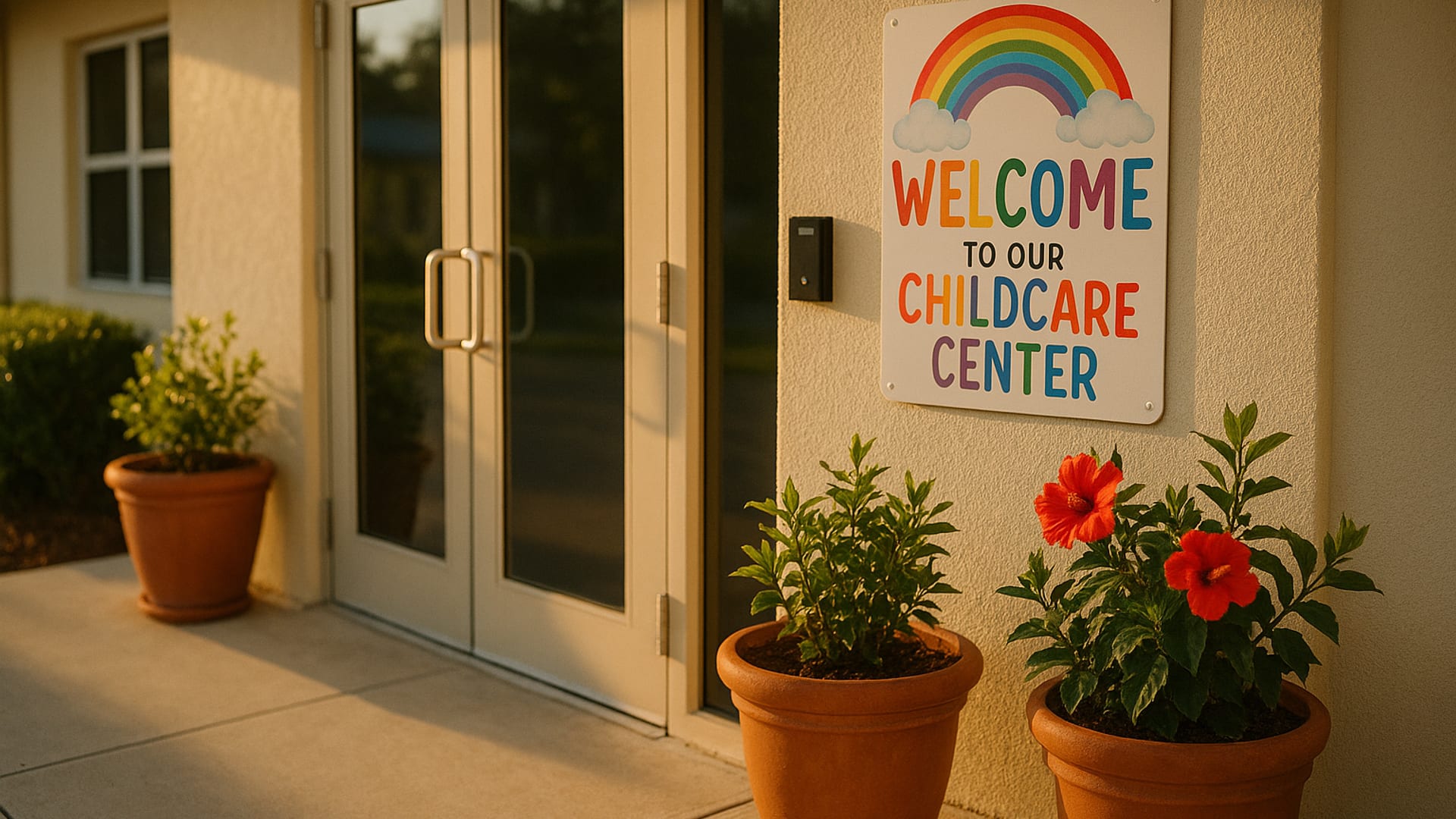
The drop-off line is your daycare’s perimeter.
Every morning, a few dozen parents arrive within about thirty minutes of each other. They are tired, running late, and thinking about their day. Your staff is greeting children, checking in, and trying to keep the rhythm moving.
In that thirty-minute window, more small security decisions happen than in the entire rest of the day.
This is where Florida daycare security actually lives or dies. Not in the DCF inspection. Not in the background check binder. In the drop-off line.
What DCF requires, and what DCF does not.
Florida’s Department of Children and Families licenses child care facilities in Florida. Their requirements set a floor:
- Level 2 background screening for owners, employees, substitutes, household members, and volunteers working more than 10 hours per week
- Documented emergency plans including fire, evacuation, and severe weather
- Supervision ratios, ingress and egress standards, and fire safety compliance
- Director-level training requirements and ongoing continuing education
- Provisional license options for certain DoD-trained providers moving into Florida
All of that is the minimum. What DCF does not require is the thing that actually matters most: a tight, practiced, human protocol for the first and last thirty minutes of every day.
That part is on you.
The five gates of daycare security.
We audit child care facilities across Lee and Collier counties using a five-gate framework. Each gate is a decision point. Each one, done well, stops problems before they compound.
Gate 1: Enrollment
Security begins before a child arrives for their first day. The enrollment process is a data-collection exercise that matters more than parents usually realize.
What should be captured:
- Photo ID for every authorized pickup person, on file
- Custody documents where applicable, reviewed by the director
- Emergency contacts ranked in priority order
- Explicit written do-not-release names where a family situation requires it
- Medical information and release authorization
This file lives in a place where the front desk can reach it in under ten seconds. That last part is often the gap.
Gate 2: The Drop-Off
Single-point entry. One door. One adult at that door during drop-off. Everyone who enters is seen, greeted, and logged. No exceptions for “I’ll just be a second.”
The hardest part of this is not the door. It is the culture. Parents will, in good faith, try to slip in a side entrance when they are running late. Staff will, in good faith, hold a door for a parent they recognize. The director’s job is to protect the protocol from friendly erosion.
Gate 3: The Interior
Once a child is in the building, the perimeter shifts. Interior security is about supervision, sight lines, and the everyday layout of your program.
We look for:
- Classrooms where a teacher can see every child at all times without moving
- Bathroom routines that keep children in line of sight or supervised in pairs
- A clear protocol for when a child leaves the room (who accompanies, who covers)
- Outdoor play areas with a clearly defined perimeter that staff actively monitor, not just glance at
Gate 4: The Pickup
Pickup is drop-off in reverse, with a critical twist: the people arriving are often not the ones you met at enrollment. Grandparents. Aunts. A parent’s new partner. A rideshare driver, occasionally, in 2026.
The protocol is simple and not negotiable. No child leaves with anyone not on the enrollment list. Verification happens every time, even for people the director personally knows. The moment that rule bends, it becomes the rule that can be bent.
Gate 5: After-Hours
The daycare at 7 PM is a different facility than the daycare at 7 AM. Cleaning staff, maintenance, unlocked doors during trash takeout, and lone directors closing up are all security considerations that do not appear during licensing visits.
A good daycare has a written close-of-day procedure that the last person follows every night, and a well-designed “lone worker” protocol for directors who are the last one in the building.
Background checks: what they catch, and what they miss.
Florida’s level 2 background screening is one of the better state systems in the country. It pulls FBI fingerprint records, state criminal records, and sex offender registries. Personnel covered includes not just employees but also owners, substitutes, household members, and qualifying volunteers.
What level 2 does well:
- Catches most prior convictions and registered offenders
- Maintains reasonable continuity (screenings are re-run on a schedule)
- Covers the largest category of internal risk
What level 2 does not do:
- Catch patterns of behavior that have not yet resulted in a record
- Flag someone whose household has changed since their last screening (new boyfriend, relative moved in)
- Capture the grey zone of “volunteer” who is actually present more than 10 hours per week but who never formally crossed that threshold in paperwork
The internal threat nobody wants to talk about.
National data on child abuse in daycare settings consistently points to a difficult truth. Most incidents involving children in child care facilities are committed not by strangers off the street, but by people in or connected to the organization.
This is why background screening is necessary but not sufficient. It is why supervision, sight lines, and a culture where staff feel safe reporting concerns about each other matter more than any lock.
It is also why a quiet, trusted security advisor is a valuable asset. Someone outside the daily team who can review procedures, ask the uncomfortable questions, and hold up a mirror to patterns the director is too close to see.
The standard of care for children is higher than the standard of care for anything else. Christianity has said this plainly for two thousand years. The operational question is whether our daycare practice reflects it.
The Southwest Florida context.
Our region has specific pressures that shape daycare security:
- Seasonal population swings. Fort Myers and Cape Coral daycares often see enrollment changes in winter months as snowbird families bring grandchildren for extended visits. This creates temporary pickup authorization complexity that a steady roster does not.
- Hurricane exposure. Every Southwest Florida daycare must have a severe weather plan. The 2022 Hurricane Ian season demonstrated that facilities with current, rehearsed protocols recovered and reopened far faster than those with binders of untested plans.
- Rapid growth. Lee and Collier counties have added population at a national-leading pace. New facilities open regularly, staffing pools shift, and licensing agencies are at capacity. The practical result: a daycare operator cannot assume a recent inspection caught everything.
- Multi-family housing density. Areas of Naples, Fort Myers, and Estero have seen significant multi-family construction. Daycares embedded in mixed-use buildings face access-control considerations that standalone facilities do not.
A practical next step.
If you operate a daycare in Southwest Florida and you’re thinking about what to do next, the short version is this:
- Walk your facility tomorrow morning during drop-off. Count the number of unmonitored seconds. That is your exposure.
- Pull your authorized pickup list and ask yourself, for every family: is this current? When did I last verify?
- Interview your three most trusted staff members separately and ask what they worry about. You will learn something.
- Rehearse a drill: a parent insists on picking up a child they are not authorized to pick up. Your team's response is either trained or improvised.
- Consider a third-party audit. Fresh eyes catch patterns the daily team cannot see.
What the DCF inspector cannot tell you.
A licensing visit is a compliance exercise. It confirms you meet a specific list of requirements on a specific day. It does not tell you whether your team is alert, whether your drop-off line is disciplined, whether your protocols will hold up on the hardest morning of the year.
That is what we do. We are not here to replace DCF. We are here to build on top of it, so that when the hardest morning does come, your program is ready for it.
If you are a daycare director in Fort Myers, Cape Coral, Naples, or the surrounding counties, and you want someone to walk your facility with fresh eyes, we would be glad to start that conversation. We’ll listen, we’ll look, and we’ll tell you plainly what we see.
Ready when you are
Start with the drop-off line.
A focused look at your facility's most exposed thirty minutes. No theater, no scare tactics, just a plain-English read.
Schedule a daycare reviewRelated Insights
Keep reading.

The Daycare Pickup Line: Discipline That Holds Up When Everyone Is in a Hurry
Pickup is where daycare security usually breaks. Here's how a written protocol, rotation rhythm, and verification culture keep it disciplined through busy seasons.
Sandy Hook (2012): The Access Control Lesson That Still Isn't Learned
On December 14, 2012, 26 people died at Sandy Hook Elementary. The access control lesson it revealed still applies to schools, daycares, and children's ministries.

Church Security in Southwest Florida: The Complete Playbook
How Southwest Florida churches build hospitality-first security that actually works. Doctrine, teams, drills, and the layers that matter on Sunday morning.