Medication Room Security: The Overlooked Access Control Problem
Medication rooms in senior living are high-value, high-risk spaces. Narcotics diversion, shift-change gaps, and access drift need specific security discipline.
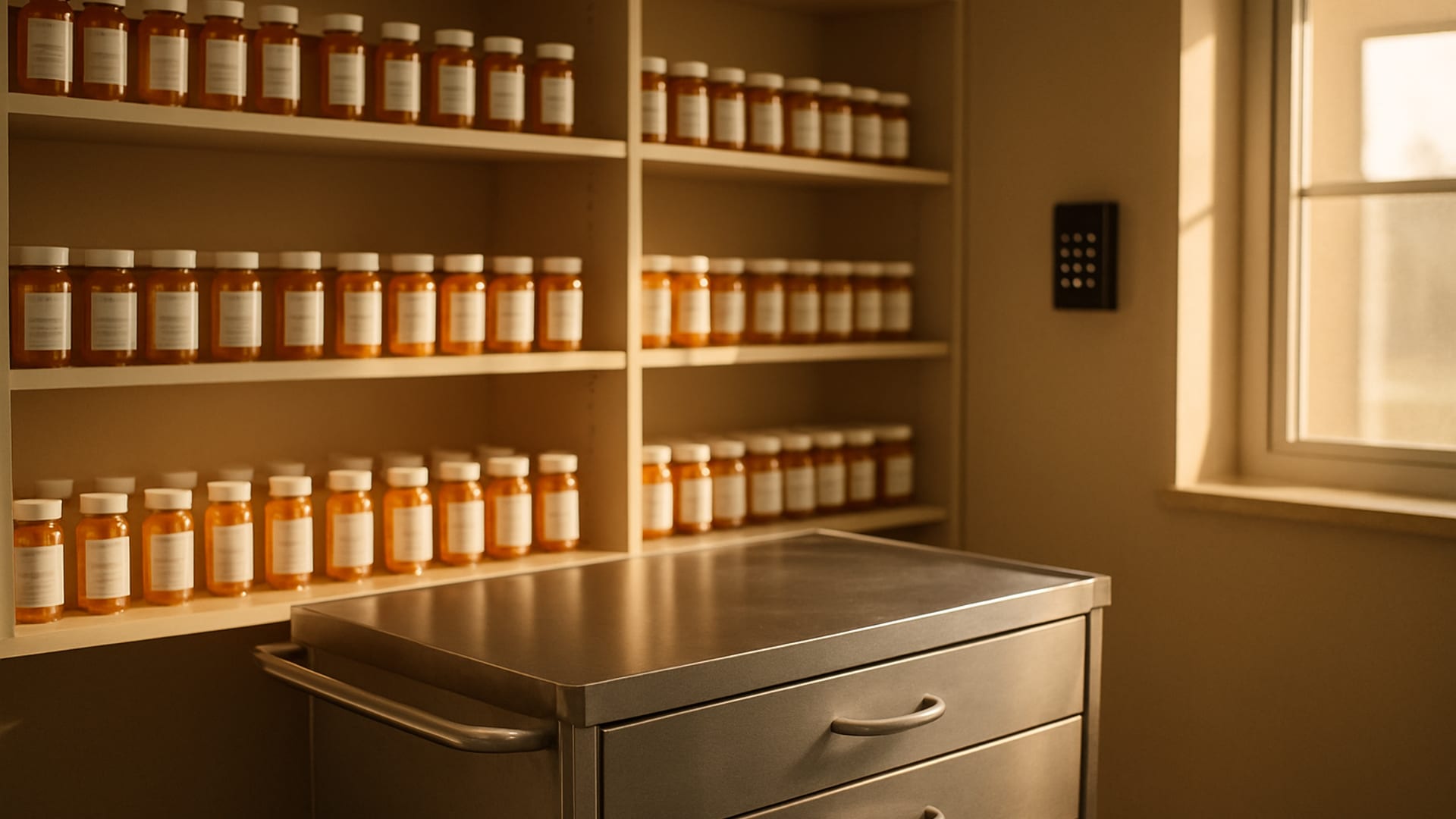
The most regulated room in the facility, and the least audited.
Every senior living facility has a medication room. It holds controlled substances regulated under federal DEA law, prescription medications regulated by state pharmacy boards, medical supplies, and a significant cumulative dollar value. The access patterns are complex. The regulatory framework is substantial. The consequences of a serious incident include DEA action, AHCA citations, civil liability, and criminal exposure.
And yet, in many facilities, the medication room is among the least independently audited spaces in the building. Its discipline is assumed based on nursing credentials and good faith. When diversion happens, it tends to happen quietly, over months or years, and the first indicator is often discovered long after the pattern has been established.
This article is about the operational security of senior living medication rooms. Not the clinical workflow. The security infrastructure, the access discipline, and the human systems around both.
The threat register.
Medication room security addresses several distinct threats, each with different characteristics.
Internal diversion by licensed staff
The most common and most serious threat. A licensed nurse, medication aide, or other credentialed staff member removes medication for personal use or sale. Often begins small, escalates over time. Detection is difficult because the person diverting has legitimate access to the room.
Warning signs that should prompt review:
- Recurring discrepancies in controlled substance counts at shift change
- Specific staff members repeatedly involved in documentation anomalies
- Patterns of waste (disposal) that exceed clinical norms
- Unusual PRN administration rates for specific residents under specific staff
Casual theft by visitors or non-medication staff
Less common than internal diversion but still present. Visitors, housekeeping, maintenance, or contractors with incidental access may take medications opportunistically. Usually smaller in volume but can escalate.
Unauthorized resident access
Cognitively impaired residents occasionally access areas they should not. Wandering into an unlocked medication room can produce life-threatening outcomes. The access control layer protects residents, not just property.
Inventory errors and mis-documentation
Not strictly security but related. Poor documentation practices create the conditions in which diversion can hide. A facility with sloppy counts cannot reliably detect diversion.
Post-incident evidence loss
After a resident incident (fall, adverse event, death), medication documentation becomes evidence. Facilities where medication rooms are loosely controlled during these periods sometimes find critical documentation missing when investigators arrive.
The layers of medication room access control.
A mature senior living medication room security program has multiple layers.
Layer 1: Physical access
- Solid-core door with a lock that cannot be easily defeated
- Electronic access control (keypad, fob, or badge) with logged entry
- A secondary lock on controlled-substance storage within the room (e.g., a locked narcotics cabinet within the larger secured room)
- Camera coverage of the door and the controlled-substance storage area
- No propped-open policy, strictly enforced, with staff culture to match
Layer 2: Documentation
- DEA-compliant inventory for all controlled substances
- Shift-change counts with dual-signature verification
- Written documentation of every access: who, when, why, for which resident
- Waste/disposal documentation with witness signature
- Reconciliation on a defined schedule (daily for high-volume items, weekly for others)
Layer 3: Personnel
- Credential verification for every staff member with med-room access
- Background check current for all access-authorized personnel
- Access removed immediately upon termination or role change
- Regular training on medication handling and documentation
- Clear escalation pathway for staff who notice concerning patterns
Layer 4: Audit
- Monthly internal audit of access logs and documentation
- Quarterly reconciliation with pharmacy records
- Annual external audit by a qualified independent reviewer
- Documented review of any discrepancy, no matter how small
- Trend analysis: tracking patterns over time, not just individual incidents
Where facilities commonly drift.
Having audited senior living medication rooms across Southwest Florida, we see consistent patterns in where discipline slips.
The always-unlocked med cart
Medication carts are supposed to be locked between administrations. In busy practice, staff often leave a cart unlocked during a resident hallway run because it saves time. During those minutes, the cart is effectively open to anyone passing through the hallway.
The shift-change shortcut
Shift-change narcotics counts are supposed to involve both outgoing and incoming staff, both signing the count. In practice, one signs off without actually counting, trusting that the other did. Discrepancies are missed. Over time, systematic small diversions become undetectable.
The delayed access revocation
A staff member resigns or is terminated. Their electronic access credentials to the medication room remain active for days, sometimes weeks. In that window, if they have bad intent, they can return to the facility after hours and access controlled substances.
The family visitor in the hallway
A family member waiting to visit their parent stands in the hallway near the open medication room while a nurse is distributing meds. Not malicious. But during that time, the family member has unsupervised visual access to the medication room and everything in it.
The contractor with incidental access
Maintenance, cleaning, or technology contractors enter the medication room during off-hours. Not for medications but because the HVAC vent is in the ceiling. They are supposed to be supervised. Sometimes they are not. Rarely with bad intent, but it creates an uncontrolled-access window.
The documentation that never matches
Over months, the pharmacy’s records, the facility’s records, and the actual inventory drift from each other. Small discrepancies become normal. No one reconciles. When a large discrepancy finally appears, the baseline is so muddy that tracking the source is impossible.
The human system around the technology.
Much of what matters for medication room security is cultural, not technical. A facility with modest technology and strong culture often outperforms a facility with sophisticated technology and weak culture.
Culture is built through:
Leadership visibility
Facility leadership visits the medication room on a regular cadence. Not to look over shoulders, but to demonstrate that the room is an area of continued leadership attention. The visit itself shapes behavior.
A reporting pathway for concerns
Staff who notice something concerning about a colleague need a clear way to surface the concern without retaliation. This is harder in small facilities where staff know each other well. But without it, concerns stay privately held until an incident forces them into the open.
Recognition for clean practice
Staff members who maintain impeccable documentation, catch small discrepancies, and raise questions about patterns deserve recognition. The culture rewards what it recognizes.
Consistent accountability
When protocols are not followed, the response is proportional and consistent. Leniency for favored staff and harsh response for others signals to everyone that the rules are negotiable. Consistent application signals that they are not.
The Florida regulatory context.
Florida’s Agency for Health Care Administration regulates medication handling in assisted living and nursing facilities with specific requirements. Key elements relevant to security:
- Documented medication storage requirements including locked storage for all medications
- Specific controlled-substance handling aligned with DEA regulations
- Assistance with self-administration documented for each resident
- Medication error reporting within defined windows
- Staff training and credentialing requirements for medication-handling personnel
- Incident reporting for theft, loss, or diversion of medications
State pharmacy regulations layer additional requirements. The regulatory framework is not ambiguous. The operational implementation is where facilities succeed or struggle.
The verse names faithfulness in small matters as the indicator of trustworthiness in larger ones. The operational parallel to medication room security is direct. The staff member who documents carefully in ordinary days is the staff member whose documentation will hold under scrutiny. The facility that maintains small disciplines consistently is the facility whose records will support it when a real investigation occurs.
Hurricane season and continuity.
Hurricane Ian in 2022 produced specific lessons for Southwest Florida senior care facilities around medication handling.
- Evacuations require transporting medications to shelter or receiving facilities. The chain of custody during transport is a known vulnerability window.
- Power outages disrupt electronic access control. Backup authorization protocols should be documented and rehearsed, not improvised during the event.
- Shelter-in-place with reduced staff produces staffing windows that can stress medication documentation discipline.
- Post-event recovery sometimes involves temporary staff unfamiliar with the facility’s normal documentation practices.
Each of these is a known risk window. Planning ahead of hurricane season, specifically for medication security during and after an event, should be part of annual preparation.
What an audit reveals.
A senior living medication room audit typically surfaces findings across several categories:
- Physical access gaps: door propped, lock broken, camera misaimed
- Documentation gaps: counts not balanced, signatures missing, disposal unwitnessed
- Personnel gaps: access active for departed staff, credentials expired, training lapsed
- Audit gaps: monthly reconciliation not performed, trend analysis absent, past findings not closed
- Cultural gaps: staff reporting pathway unclear, leadership visibility low, accountability inconsistent
Most first-audit findings are not dramatic. They are the small patterns that, if left uncorrected, become the conditions for eventual incident.
Starting this quarter.
For a facility administrator considering where to begin:
- Pull last month's shift-change counts. Confirm every one is signed, balanced, and reconciled.
- Review the access credential list for the med room. Remove any that no longer belong.
- Test the med room door physically. Is it locking reliably? Is the camera seeing what it should?
- Walk the medication room during a busy administration window. Observe where discipline weakens and where it holds.
- Schedule an external audit. Fresh eyes catch what internal review has acclimated to.
The stewardship that matters most.
Senior living residents entrust the facility with some of the most intimate elements of their care. Medications are among them. Building a medication room security program that is worthy of that trust is not bureaucratic work. It is a specific form of stewardship that reflects the culture of care the facility is trying to build.
If your facility in Fort Myers, Cape Coral, Naples, Port Charlotte, or the surrounding communities wants a fresh audit of your medication room security, we would be glad to conduct that review. Careful, discreet, actionable findings. For a broader senior living security context, see our pillar on wandering, visitors, and emergencies and our companion piece on elopement prevention.
Ready when you are
Quiet risks deserve steady attention.
We walk your facility during real operational hours and tell you plainly what we see. Elopement, visitors, emergencies, all considered.
Request a facility walkRelated Insights
Keep reading.
Elopement Prevention: Doors, Wristbands, and the Human System Around Them
Wander management works when the human system around it works. How senior living facilities build elopement prevention that actually holds up.
Senior Living Security: Wandering, Visitors, and the Emergency You Didn't Plan For
Security for assisted living and memory care in Southwest Florida. Elopement prevention, visitor control, fall response, and hurricane-season readiness.

Church Security in Southwest Florida: The Complete Playbook
How Southwest Florida churches build hospitality-first security that actually works. Doctrine, teams, drills, and the layers that matter on Sunday morning.