Senior Living Security: Wandering, Visitors, and the Emergency You Didn't Plan For
Security for assisted living and memory care in Southwest Florida. Elopement prevention, visitor control, fall response, and hurricane-season readiness.
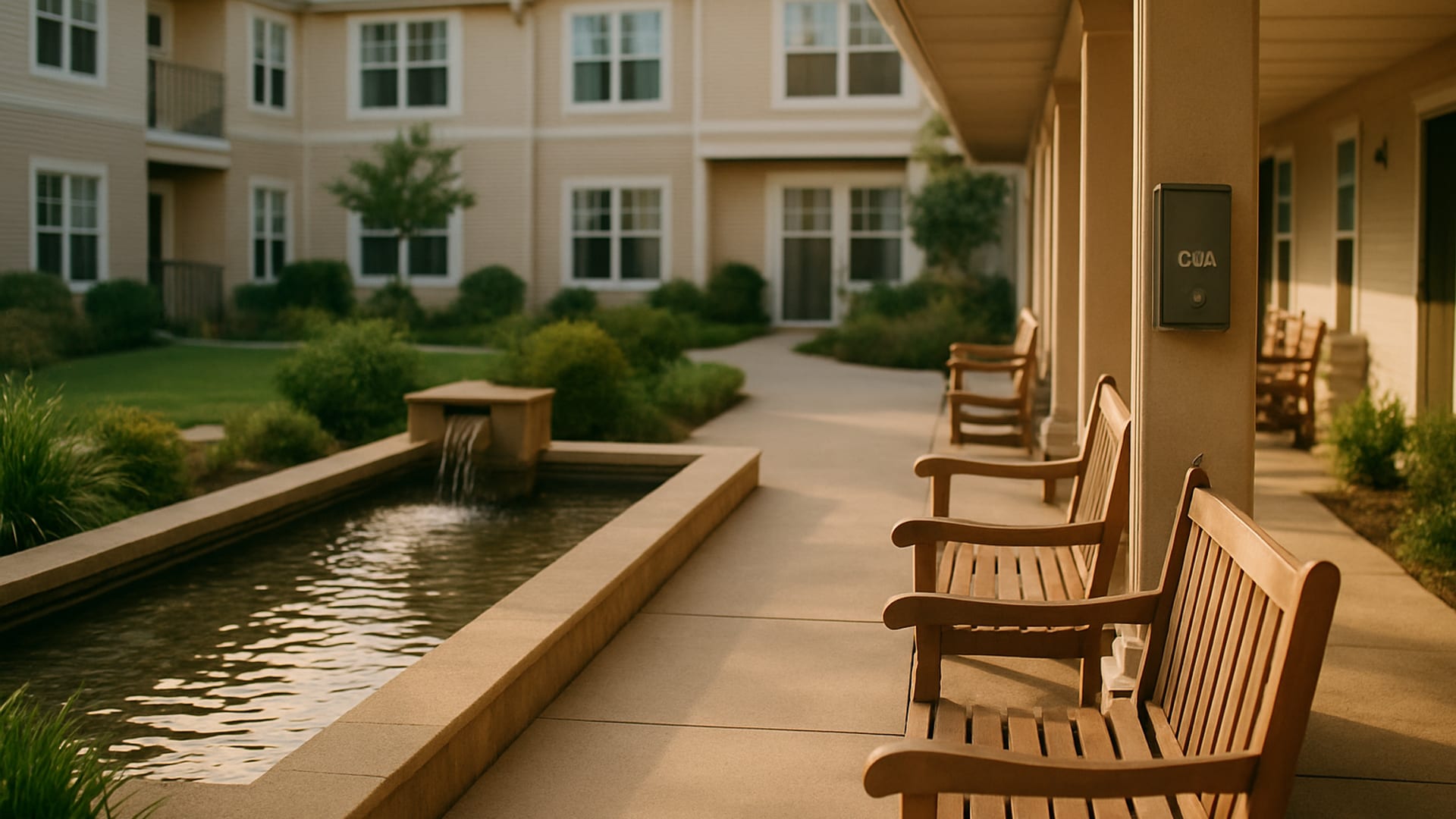
The quiet emergencies outnumber the loud ones.
A television drama about senior living security would probably feature intruders and crisis. A real week in a real facility is mostly quieter and harder: a resident wandering out a back door on a humid afternoon, a son-in-law showing up unannounced with a clipboard, a UTI that changed behavior before anyone noticed, a power blip that just disabled the hallway cameras nobody checks.
The security work in senior living is not dramatic. It is patient, procedural, and relentless. Done well, it is almost invisible. Done poorly, it is a tragedy waiting for a spark.
This is how we think about senior living security across Southwest Florida.
The actual threats, in order of frequency.
Most senior living security plans are built around threats the facility will probably never face. Active shooters. External intruders. Dramatic, media-shaped scenarios.
The real threat register looks different:
- Elopement and wandering, especially among memory care residents
- Falls and medical emergencies that require rapid response
- Financial exploitation by family members, vendors, and opportunistic outsiders
- Medication diversion and theft of personal property
- Abuse and neglect, often by people with legitimate access
- Severe weather and power outages (a Southwest Florida specialty)
- Staff turnover that breaks continuity of care and security
Note what is not on that list: a stranger breaking in with violent intent. That threat exists, but it is orders of magnitude less common than the ones above, and the protocols that protect against elopement and visitor fraud happen to also address it.
Elopement: the single most serious recurring risk.
A study widely cited across senior-living risk management estimates that roughly 60 percent of people living with dementia will wander at some point. ECRI Institute has estimated wandering rates of about 36 percent in community settings and up to 65 percent in nursing home settings. National reporting has documented more than 2,000 wandering incidents from assisted living and memory care since 2018.
Those numbers translate directly into the operational question every memory care director carries: is every door in our facility accounted for, right now, for every resident?
The technology exists: wander management systems, door sensors, wristband-based RFID. The protocols exist: rounding, verified supervision, controlled egress. What usually fails is not the technology. It is the integration.
- A door sensor that alerts a staff station nobody is monitoring.
- A wristband system that drains batteries on a schedule nobody tracks.
- A “quick check” round that skips a resident when staff are short.
- A door propped open during a delivery that nobody remembers to shut.
Visitor management: the category most facilities under-build.
Visitor management is often treated as a reception task. It is not. It is a security function that happens to live at the front desk.
A mature visitor protocol does three things:
- Creates an unbroken record. Every visitor, every time, logged with time in and time out.
- Filters access by role. Family, vendor, clinician, and guest all have different levels of access to different areas.
- Flags anomalies. Repeated visits to a resident who has no family listed. A vendor who arrives after hours. A “social worker” with no credentials.
The reason this matters for senior living specifically: financial exploitation of older adults is one of the most under-reported and most damaging categories of elder abuse, and it almost always involves someone who had legitimate or semi-legitimate access.
A visitor log that nobody audits is a visitor log that is not actually doing work. We find this often.
The senior living emergency plan, revisited.
Every licensed senior living facility in Florida has an emergency plan on file. Most of them are several years old, copied in part from a template, and have not been rehearsed since the last inspection.
That plan is the document that will, or will not, save lives in a real emergency. We review it against six questions:
- Does it reflect the current layout of your facility? Many do not. Wings get added, doors get reconfigured, and plans do not always keep up.
- Is the staff currently on shift trained on it? Staff turnover in senior living is significant. An untrained staff is an un-planned facility, regardless of what is in the binder.
- Does it distinguish between shelter-in-place and evacuation, with clear criteria for each? Generic “follow the plan” language is not a plan.
- Does it address the specific vulnerabilities of your residents? An evacuation plan for an independent-living population is fundamentally different from one for a memory care wing.
- Has it been practiced? A plan that has never been run under pressure is a hypothesis, not a plan.
- Does it have a clear chain of communication with families? The plan that fails after an event is often the one that did not account for frantic families calling at 2 AM.
Hurricane Ian and what it taught Southwest Florida.
On September 28, 2022, Hurricane Ian made landfall near Cayo Costa as a catastrophic Category 4 storm. Southwest Florida senior living facilities were among the most affected of any category of institution. Evacuations, shelter-in-place decisions, power outages, and transportation failures all came to a head simultaneously.
What the post-Ian reviews revealed was consistent. Facilities that had rehearsed their plans, maintained current resident rosters with specific medical needs clearly flagged, and pre-negotiated relationships with county emergency management recovered and protected residents far better than facilities that had not.
The correlation was not with size. It was not with budget. It was with preparation.
The psalm is a prayer on behalf of the aging. It is also, read as an operational charge, a description of what senior living is for. The security work we do is in service of that charge.
Building a program, not a plan.
The difference between a senior living facility that handles its security well and one that does not is almost never the quality of the plan on paper. It is whether that plan has become a program.
A plan is a document. A program is a rhythm.
A program includes:
- Monthly walk-throughs with someone outside the daily team
- Quarterly tabletop exercises on a rotation of scenarios (elopement, medical, severe weather, intruder, power)
- Annual full audit of policies, technology, and personnel
- A named security point-of-contact with the authority to escalate and the standing to be heard
- Continuous training that survives the departure of any one staff member
- A working relationship with local LE, fire, and EMS, built during quiet times
Most of those items do not require new spending. They require a culture that takes security seriously in January the same way it will wish it had in September.
The Southwest Florida context.
Our region concentrates a number of senior-living-specific pressures:
- Demographics. Lee, Collier, and Charlotte counties have some of the highest senior populations per capita in the country. The concentration of memory care and assisted living facilities is correspondingly high.
- Hurricane exposure. No security plan is complete without a mature severe-weather response. After 2022, no operator in our region is unaware of this.
- Seasonal staffing. Winter months bring travel nurses, seasonal aides, and short-term staffing agencies. Visitor protocol integrity depends on staff who understand why the protocol matters, not just how to run it.
- Family geography. Many residents in Naples and Fort Myers have adult children in other states. This shifts communication, visitor patterns, and financial oversight in ways that affect security.
Where to start.
If you run an assisted living or memory care facility in Southwest Florida and you are asking what to actually do this month, the short list is this:
- Do a 72-hour elopement self-check: for every memory care resident, can you confirm supervision and location right now?
- Pull your visitor log from last month and look for anomalies. Any visitor you don't recognize? Any repeat visits to a solitary resident?
- Walk the perimeter of your facility at sunset. Every exterior door. Every seam. Every blind spot.
- Pick a quarterly tabletop scenario and schedule it. Anything you rehearse is better than nothing.
- Invite an outside advisor to review your plan. Fresh eyes catch what the daily team cannot.
Deeper dives on specific topics.
This article is the overview. Two topics deserve their own deeper treatment, and we have companion pieces for each:
- Elopement prevention: the doors, wristbands, and the human system around them. Our most serious recurring senior living risk, broken down layer by layer.
- Medication room security: the overlooked access control problem. Narcotics diversion, DEA compliance, shift-change gaps, and the culture around them.
Read Elopement Prevention: Doors, Wristbands, and the Human System Around Them and Medication Room Security: The Overlooked Access Control Problem for the operational depth on each.
The work is worth it.
The residents in your care are among the most vulnerable people in our communities. Many cannot advocate for themselves. Many have trusted the facility with everything they own and every decision they still have to make.
Security is not the most visible part of caring for them. It is among the most important. Done well, it is what allows the rest of the caregiving to happen without fear.
If you want someone to walk your facility with you, listen to your team, and tell you plainly what they see, we would be glad to be that someone. No theater. No pressure. Just a clear, honest look at what you have and what to do next.
Ready when you are
Quiet risks deserve steady attention.
We walk your facility during real operational hours and tell you plainly what we see. Elopement, visitors, emergencies, all considered.
Request a facility walkRelated Insights
Keep reading.
Elopement Prevention: Doors, Wristbands, and the Human System Around Them
Wander management works when the human system around it works. How senior living facilities build elopement prevention that actually holds up.

Medication Room Security: The Overlooked Access Control Problem
Medication rooms in senior living are high-value, high-risk spaces. Narcotics diversion, shift-change gaps, and access drift need specific security discipline.

Church Security in Southwest Florida: The Complete Playbook
How Southwest Florida churches build hospitality-first security that actually works. Doctrine, teams, drills, and the layers that matter on Sunday morning.